

“The only thing we could assume is that it was a game of target by Israeli soldiers.”
~ Dr Nick Maynard
It’s a strange thing to watch a film, full of powerful images, and yet find that the visual that haunts you most is something you have not seen.
And Life Support, a new documentary largely shot and narrated by medics attempting to save lives in Gaza, is from the start a journey through unforgettable scenes. The international doctors who tell the story are the only outside witnesses able to get through Israel’s blockade, Life Support documents their attempts to assist Palestinian healthcare workers in impossible circumstances.
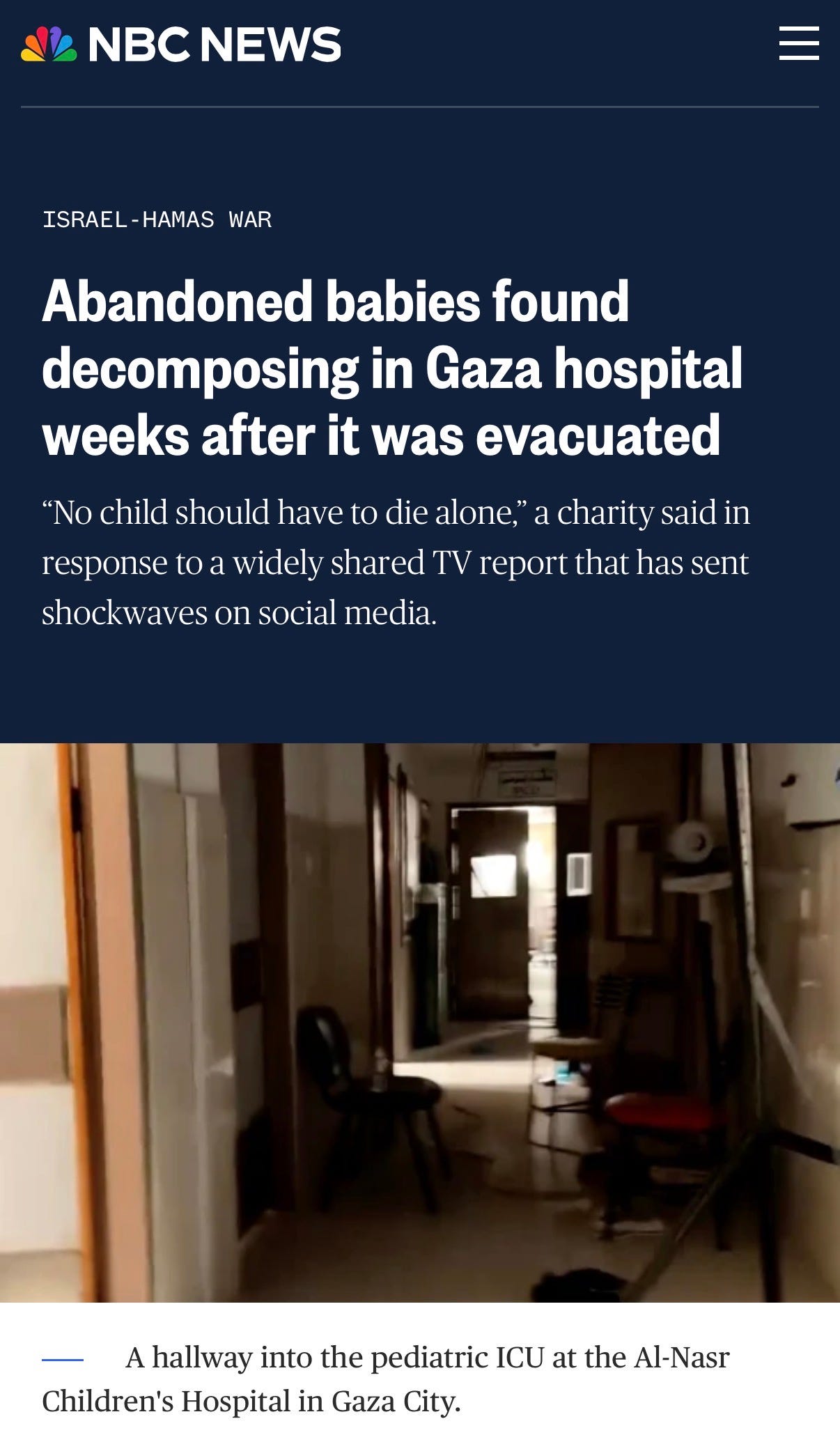
The images seared into my mind will, we can only continue to demand, become evidence for the war crimes and genocide investigations that must follow. They include; the Gaza strip before and after it was reduced to rubble, the feel of a shopping street full of people before it explodes, right in front of your eyes, in an Israeli blast. The sight of babies, emaciated and listless, clinging to survival after being inflicted with trauma wounds, or caked in the dust of collapsed buildings. The footage, reported in the international media, of newborn babies left to die and decompose while still attached to their incubators, after the medics caring for them were forced to leave Al-Nasr hospital by Israeli soldiers at gunpoint. This last story in particular I continue to find too devastating to comprehend.
But there is this testimony that stands out – not because it is the most violent experience in this film – but because it is one of the cruellest. But before the film gets there, it shows the evolving patterns in injuries and health crises that the population of Gaza have experienced.
Explosions
“I have never seen anything as intensely horrific and constant inflicted on children. I remember thinking to myself, wow this is two months after the ICJ ruling on plausible genocide, this is the worst thing I have ever seen in my life. It can’t get worse.”
~ Dr Tanya Haj-Hassan
Dr Maynard, like all the doctors in the film, describes changes in the types of injuries they were seeing in the Palestinian population, over the two year period from October 2023, during which they were regularly visiting and administering healthcare.
At first, the doctors describe trauma from heavy explosions and drone strikes. This in itself is horrific.
Dr Tania Haj-Hassan, a paediatric intensive care doctor, breaks down in the film. In spite of her years’ experience of treating sick children, her anguish at the scale and horror of violence wrought on children in Gaza is raw and palpable.
“Because of the nature of the weapons used, the blasts were so powerful, a lot of children would end up with internal bleeding, internal damage to vital organs. So you see nothing on the outside. They look unscathed. But they are actually already dead,“ says Dr Haj-Hassan.
Starvation
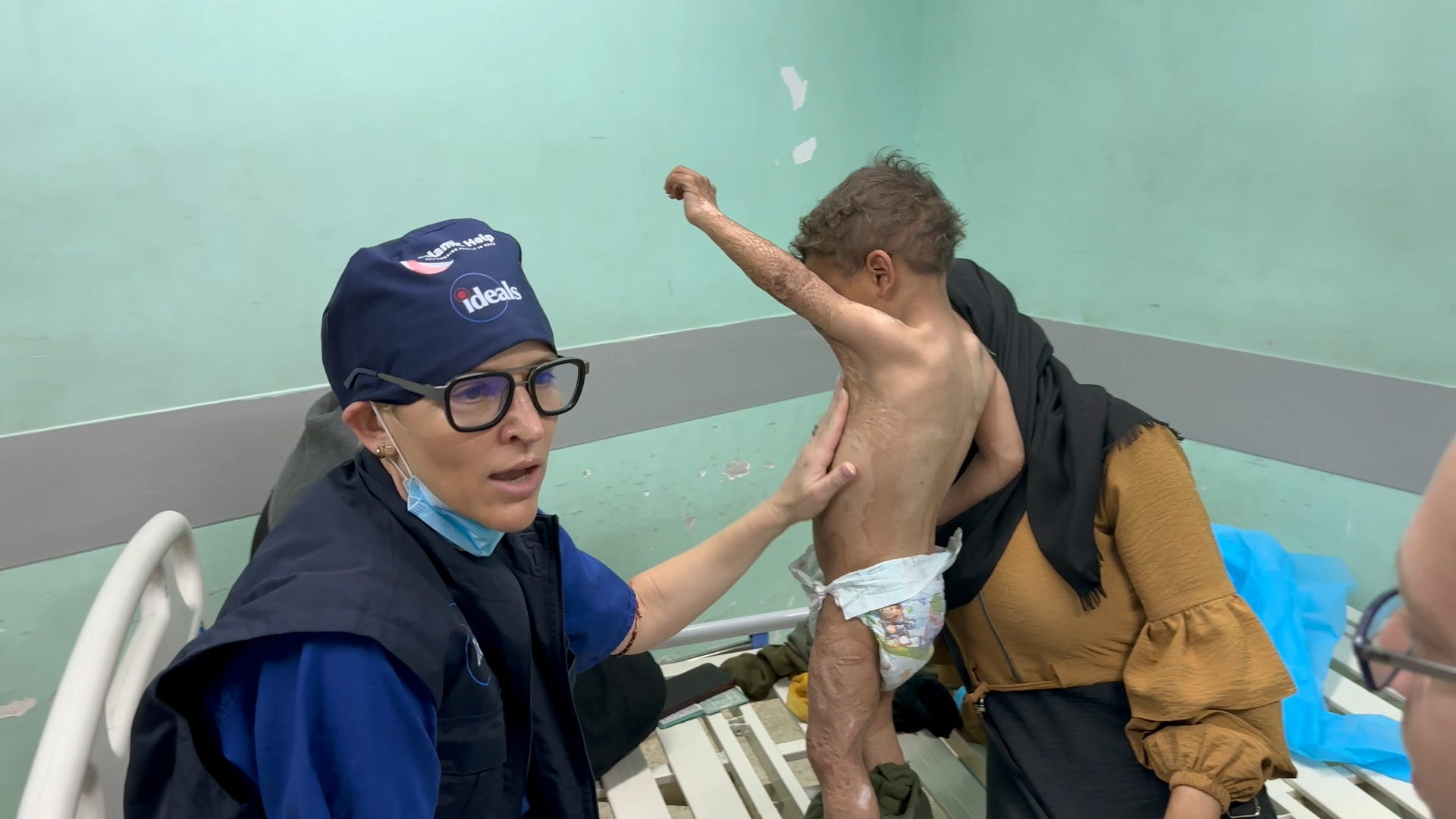
The next phase of civilian suffering in Gaza worsens with malnutrition and starvation, as Israeli blockades target crucial food and medical supplies, surgically removing baby formula for example, even from the luggage of incoming medics attempting to bring it for sick babies on the ward.
Famine was declared in Gaza in 2025, and its effects have not only been confined to patients. Maynard also describes operating, in theatre, with doctors who would faint during surgery because they were so hungry. His colleagues, he says, would put their head between their legs, and then get back up and carry on.
Aid began to re-enter Gaza in 2025 - more on that shortly - and the numbers of people affected by acute malnutrition began to decline. But at the time of writing, a new UNICEF survey has found that 12.2 per cent – one in eight children – in Gaza were chronically malnourished, or stunted, reflecting, the aid organisation says, “the cumulative toll of more than two years of war.”
The numbers facing acute malnutrition are down to 1%, still an unacceptable number in a manmade crisis. But for all children, the damage through stunting to brain development and health can be permanent, even after the acute shortage of food declines.
As aid began to re-enter Gaza in 2025, another, new plague affecting Palestinian victims the doctors treat - bullet wounds.
Target Practice
Nick Maynard, a leading consultant gastrointestinal surgeon at Oxford University Hospital, describes something I will never be able to unsee. The practice, by the Israeli military and its contractors, of what seems to me like the gamifying of shooting Palestinians. By targeting specific body parts in patterns that appear arbitrarily set.
When Israel re-opened aid supply facilities in February 2025, it was administered through the Gaza Humanitarian Foundation (GHF), run by the IDF and Israeli-hired contractors.
The GHF was quickly condemned by the United Nations for entangling “Israeli intelligence, US contractors and ambiguous non-governmental entities.” And its personnel were shooting people as they came seeking food. More than 1,000 Palestinians were killed while attempting to obtain aid, thought the only channel it was made available.
I remember when this happened. It was widely reported that these new, Israeli run GHF sites, which had the words “humanitarian” and “aid” in the title, were actually being used to spy on and kill Palestinians. At the time, I remember asking myself, from an international legal standpoint, how much more criminal could Israel’s conduct be at this point?
Then I heard Dr Maynard’s testimony in this film.
The difference in June, July 2025 was the numbers of gunshot wounds that we were seeing. I’d seen a handful of gunshot wounds on previous trips, mainly from quadcopters, but we were seeing lots of gunshot wounds from people who were reportedly shot at the GHF food distribution points by Israeli soldiers
One day they’ll see almost exclusively gunshot wounds to the head. Another day they’ll see gunshot wounds to the neck. Another day they’ll see gunshot wounds to the abdomen, or to the left arm or the right arm. It’s almost as if – this is the way my emergency department colleagues describe it whom I know very well – it’s almost like the Israeli soldiers are playing a game.
One day there were four young teenage boys who came in, all of whom had been shot in the testicles. I didn’t treat them, they were being treated by the urologists. But we all needed to discuss these patterns. And the clustering of injuries, the pattern of injuries, was so striking, that it was inconceivable that it could have been coincidence. The only thing we could assume is that it was a game of target by Israeli soldiers
It’s behaviour that I never would have believed would have been possible in this world were I not witnessing it with my own eyes.
These reports have been corroborated by other international doctors.
Chaos by Design
There are so many other details that will stay with me.
Dr James Smith, an ER Doctor, describing the conditions of treating patients in chaos and filth as hospitals came under constant attack.
“We were treating patients for the most part on the floor. We would often have upwards of 8, 10 patients on the floor. At times, we had to step over patients to reach other patients. Patients’ blood would be mixing on the floor. It was just horrific really.”
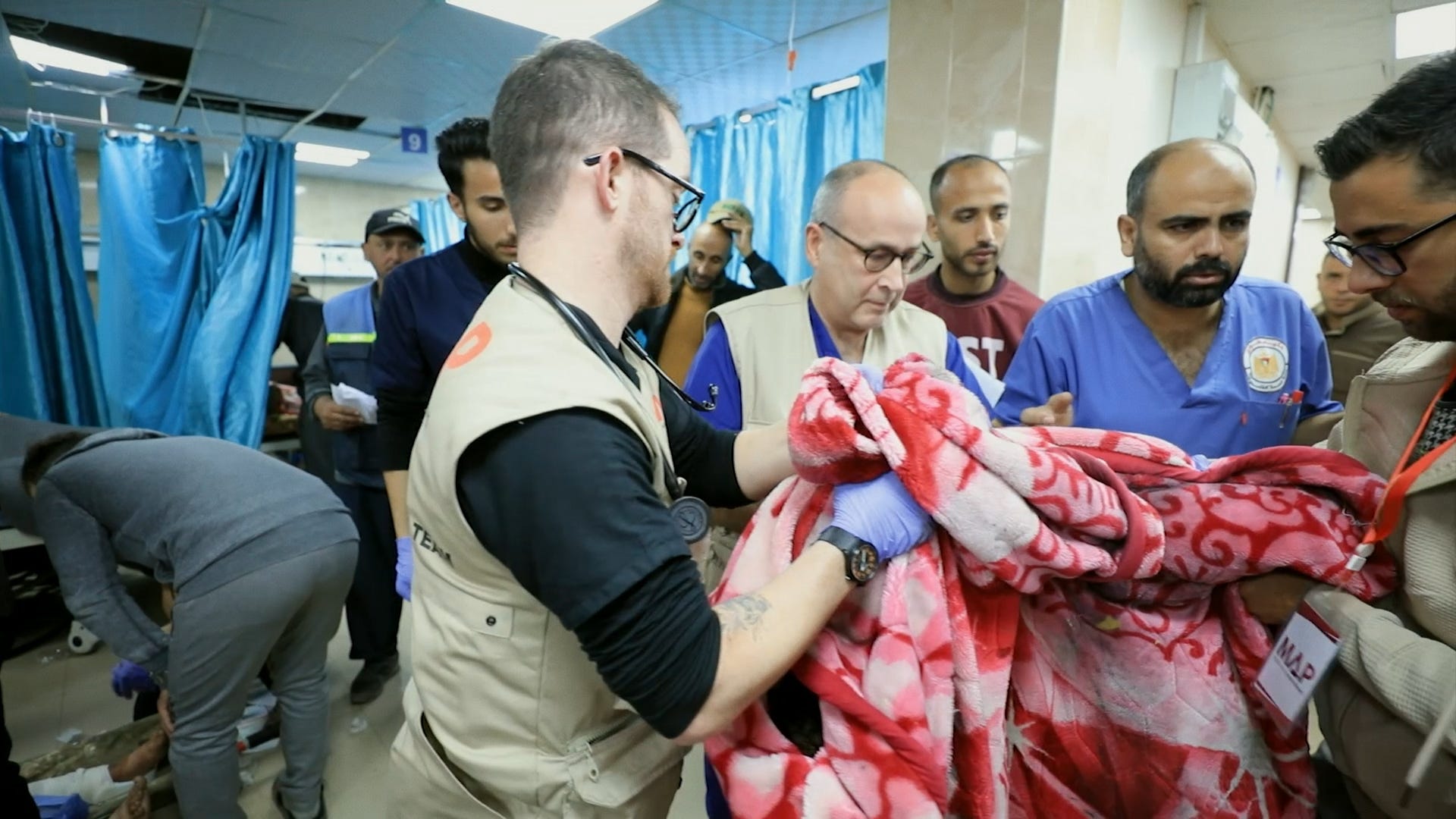
Dr Smith, who has been practising as an ER doctor for a decade, described the experience as “the most horrific things that I have ever experienced as an emergency doctor.”
Dr Smith had also just returned from Gaza earlier this week. He describes the gulf between the ongoing humanitarian crisis in Gaza, and the dwindling news coverage as the story becomes old news. On the day of our screening, the medical supply warehouse inside the Al-Aqsa Martyrs Hospital complex was again attacked by an Israeli drone strike.
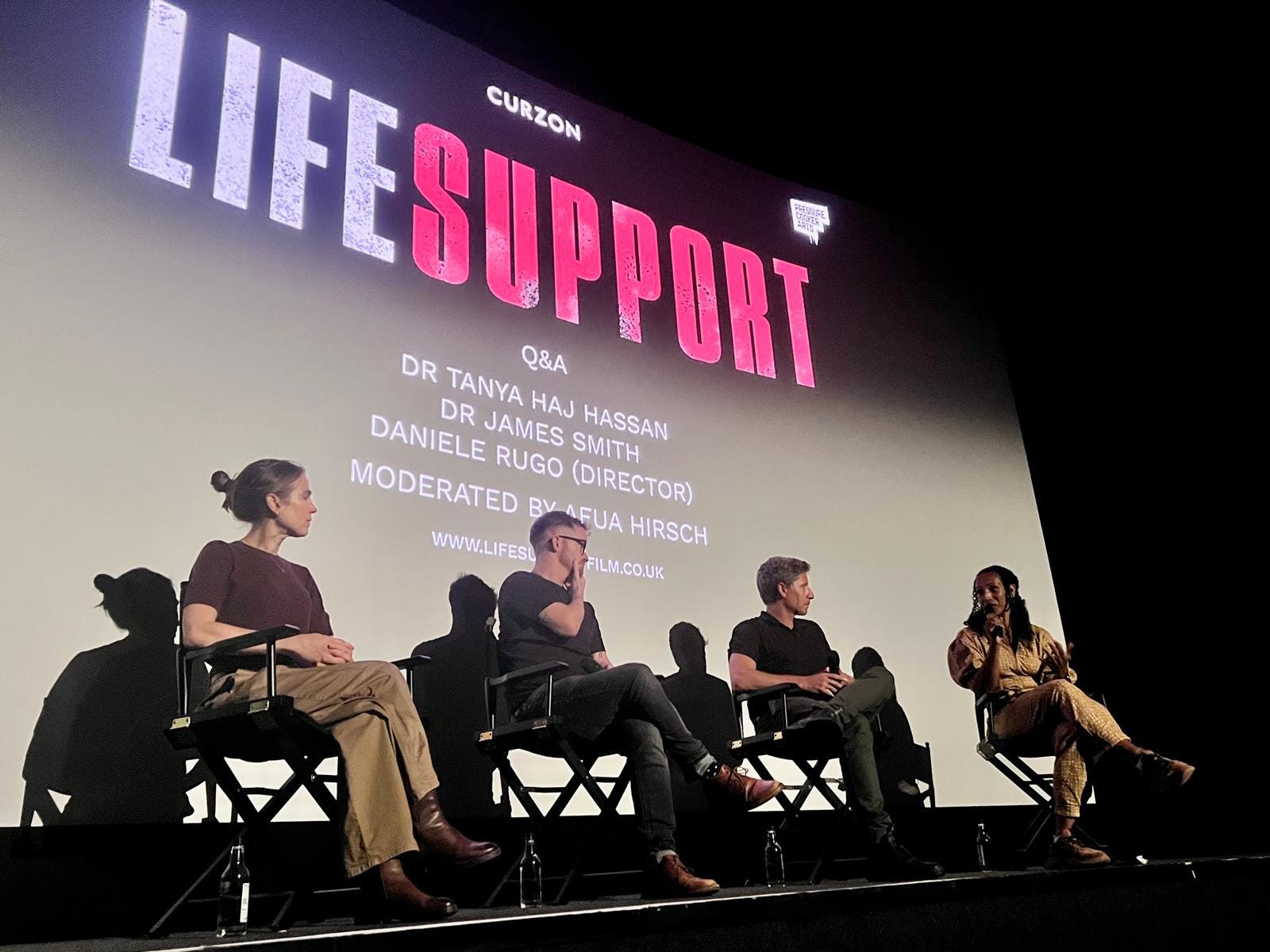
Dr. Khaled Dawas Consultant Surgeon, Hon Associate Professor, Head of Regional Upper Gastrointestinal Service at University College London, described the tragedy of seeing patents through surgery, in spite of all these conditions, only for them to die anyway because of the lack of after care.
“The number of patients who had what we would deem as successful surgeries... We would do what we deemed appropriate. The number who died three or four days later, because they had no nutrition, because there were no antibiotics, because there was no one to pick up when things went wrong, and there was no way of being able to – as you do in intensive care – watch over them like a hawk for the first few days. That didn’t happen.”
Perspective
Testimonies like Life Support are not a substitute for hearing the stories of Palestinians, particularly those in Gaza, first hand. Like the also brilliant film Gaza: Doctors Under Attack which was released on Channel 4 last year, the fact of these stories is in itself a recognition that storytellers are having to do whatever it takes to get people’s attention. Celebrity Executive Producers; in this case, Melissa Barerra, Susan Sarandon, Paul Weller, Asif Kapadia, and more. Recognition from awards institutions like BAFTA, judges for which were in the audience this weekend. And British and North American trained professionals like the doctors in this film. Films like this raise a question why listening to Gazans themselves is not enough. They also answer that question by showing what the resources and endorsement of western filmmakers can do in garnering attention. A power dynamic which is in itself part of the power dynamic that must be critiqued.
That has not stopped the Israeli authorities attempting to smear these projects, often dismissing these intensely credible accounts as “fake news”. At the time when Gazans were being shot at the GHF ‘humanitarian’ centers in their hundreds, the US ambassador to Israel, who backed the GHF operation, went on the record saying their success was “phenomenal”.
The GHF has since ended its operations following the October 2025 ceasefire and the resumption of UN access.
Speaking of the US, this administration has a tendency to dehumanise - a classic hallmark of genocidal behaviour - in the past for example, describing populations living under challenging conditions as “shithole countries”, even when the US has played a significant part in creating those conditions itself. Hard to compute, or even imagine, but maybe detractors watching this are telling themselves, this is just how Palestinians live.
One of the doctors in Life Support says something that really drove home to me how fatal the deliberate targeting of healthcare infrastructure, and patients, by Israel has been. That for a society, and a healthcare system, this onslaught has in fact been unsurvivable.
“You are working with sometimes no electricity, no instruments, no clean instruments, no gauze, at one point we were running out of bandages. Those patients required multiple operations because infection seeds in,” said paediatric orthopaedic surgeon Dr Ana Jeelani.
“There is no advanced healthcare anywhere in the world that could deal with what’s happening in Gaza.”
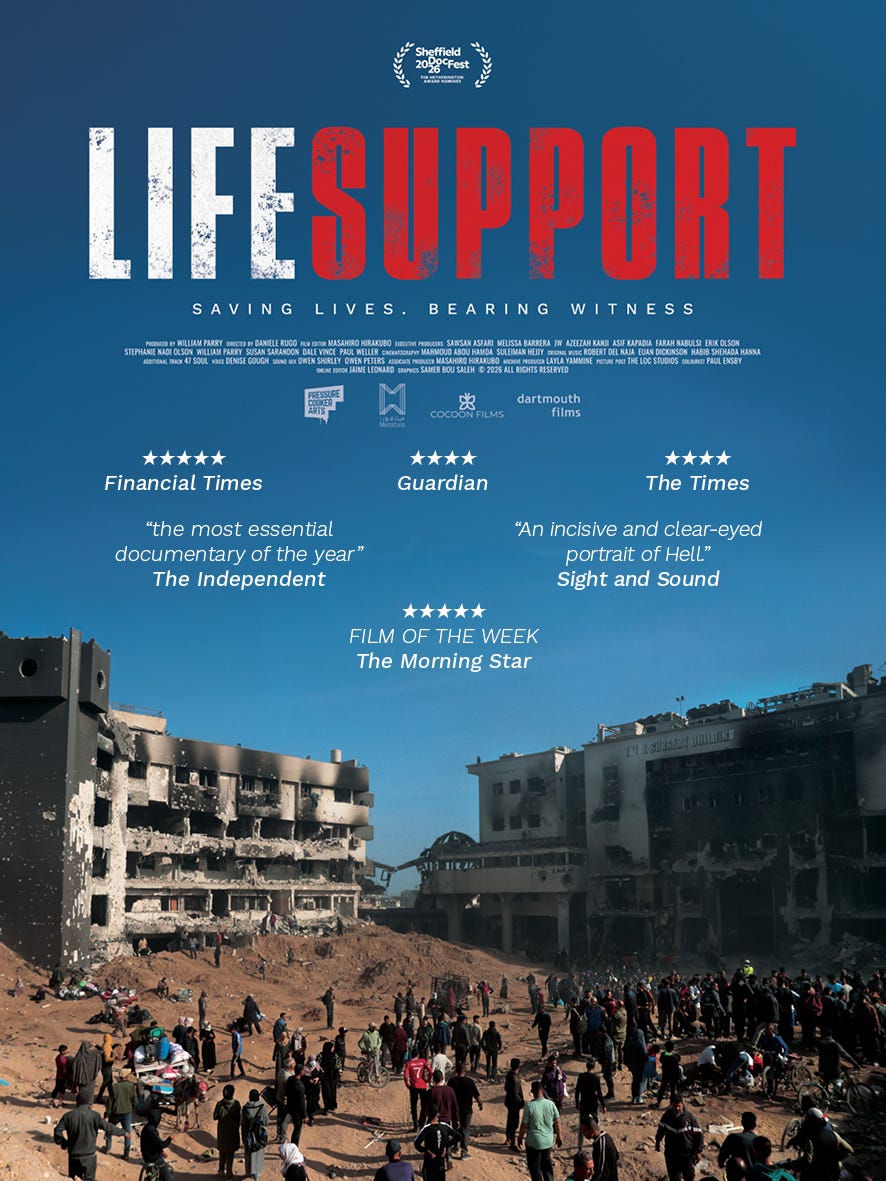
*There are more screenings of Life Support - details here. Produced by William Parry, Pressure Cooker Arts, and directed by Daniele Rugo.